
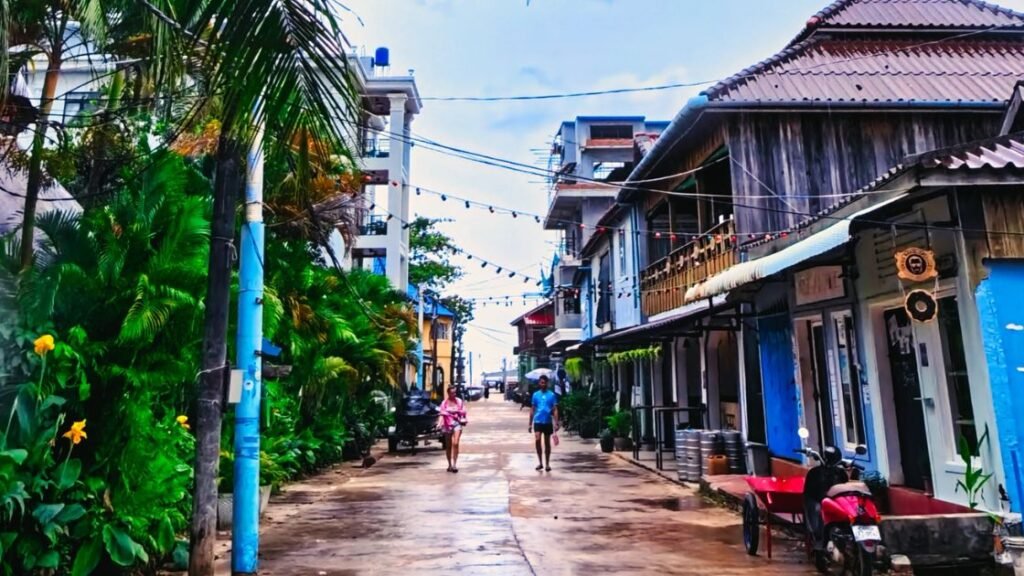
From Village 23 to Island Paradise:
Discover The Remarkable History of M’Pai Bay, Cambodia
The history of M’Pai Bay, Cambodia reveals a captivating transformation from colonial logging operation to authentic fishing village to beloved backpacker destination. This small bay on Koh Rong Sanloem’s northern coast carries within its name — literally “Village 23” in Khmer — the echoes of Cambodia’s complex past and the resilience of its coastal communities.
Unlike many Southeast Asian destinations where history begins with tourism development, M’Pai Bay history Cambodia spans over 150 years of documented activity, from British colonial surveys to French logging operations, wartime incidents, and the gradual evolution into today’s authentic fishing village that welcomes travelers from around the world.
The British Connection: Early Maritime Exploration
M’Pai Bay history Cambodia begins with maritime exploration in the mid-19th century. In 1857, the British Royal Navy’s HMS Saracen conducted comprehensive surveys of Cambodia’s coastline and islands, creating the first detailed maps of the region. This historic surveying mission not only charted safe passage routes for merchant vessels but also gave the neighboring Saracen Bay its enduring name.
The British surveys marked the first systematic documentation of M’Pai Bay’s protected waters and strategic location. Naval cartographers noted the bay’s excellent natural harbor, calm conditions, and proximity to mainland Cambodia — characteristics that would prove significant throughout subsequent historical periods.
These early maritime charts established M’Pai Bay history Cambodia as part of broader colonial-era exploration efforts across Southeast Asia. The detailed coastal surveys conducted by HMS Saracen became foundational documents for later French colonial administration and economic development projects.
French Colonial Era: The Birth of “Village 23”
The most defining chapter of M’Pai Bay history Cambodia occurred during French colonial rule (1863-1953), when the bay transformed from uninhabited coastline into an active logging operation. French colonial administrators established systematic numbering for remote work camps and settlements, designating this northern bay location as “Village 23” — M’Pai in Khmer.
M’Pai Bay history Cambodia during the French Protectorate period centered on extracting valuable tropical hardwoods from Koh Rong Sanloem’s dense interior forests. Colonial logging operations required significant infrastructure development, including basic road networks connecting different parts of the island and temporary housing for workers and supervisors.
The French built rudimentary transportation routes across Koh Rong Sanloem, with M’Pai Bay serving as a crucial departure point for shipping timber to mainland Cambodia and French Indochina markets. These logging roads, though now completely overgrown by jungle vegetation, represented the island’s first systematic infrastructure development.
Evidence of this colonial period remains visible today in M’Pai Bay history Cambodia through the French-built lighthouse on Koh Rong Sanloem’s southern tip. This lighthouse, constructed during the French Protectorate, now serves as both tourist attraction and historical reminder of European colonial presence in Cambodian waters.
The Transition to Traditional Fishing
As French colonial logging operations concluded in the early 20th century, M’Pai Bay history Cambodia entered a new phase focused on traditional maritime livelihoods. The numbered “Village 23” designation gradually gave way to authentic Khmer fishing community development, though the M’Pai name persisted as a connection to this colonial past.
Local Cambodian families began establishing permanent settlements around M’Pai Bay’s protected waters, developing traditional fishing methods suited to the bay’s calm conditions and rich marine environment. These families formed the foundation of today’s authentic fishing village community — roughly 100 Khmer families who continue traditional maritime lifestyles.
M’Pai Bay history Cambodia during this transition period demonstrates remarkable continuity in community-based fishing practices. Families developed extensive knowledge of local marine ecosystems, seasonal fishing patterns, and sustainable harvesting techniques that continue supporting the village economy today.
The fishing community that emerged during this period maintained strong connections to mainland Cambodia while developing distinct island cultural practices. This balance between mainland Khmer traditions and unique island adaptations characterizes M’Pai Bay history Cambodia through the mid-20th century.
World War II and Regional Conflicts
M’Pai Bay history Cambodia intersected with broader regional conflicts during the World War II period and subsequent Indochina wars. While the island remained relatively isolated from major combat operations, its strategic coastal location meant periodic involvement in regional maritime security concerns.
The island’s isolation during wartime periods actually strengthened traditional fishing community bonds, as families became increasingly self-reliant and community-focused. This period of relative isolation contributed to preserving authentic Khmer cultural practices that distinguish M’Pai Bay history Cambodia from more developed coastal areas.
The SS Mayaguez Incident: International Historical Significance
One of the most dramatic chapters in M’Pai Bay history Cambodia occurred on May 14-15, 1975, during the SS Mayaguez incident — famously known as “the last battle of the Vietnam War.” This international crisis thrust the small fishing village into global headlines and Cold War politics.
On May 12, 1975, just two weeks after Saigon’s fall, Khmer Rouge forces seized the American merchant container ship SS Mayaguez in contested waters near Cambodia. The ship’s 39 crew members were initially taken to nearby Koh Tang island, but were subsequently moved to Koh Rong Sanloem, specifically to M’Pai Bay area, for interrogation.
M’Pai Bay history Cambodia during this incident reveals the local community’s characteristic hospitality even under extraordinary circumstances. According to historical accounts, while Khmer Rouge guards maintained security, local villagers provided the American crew with rice, chicken soup, and pickled eggplant — typical Khmer hospitality extended even to involuntary guests.
Captain Charles Miller and nine crew members were held for three days before Khmer Rouge commanders, seeking to end American bombing raids, agreed to release the hostages. The crew was loaded onto a Thai fishing boat and sent toward open waters, where they were rescued by the USS Henry B. Wilson on May 15, 1975.
This incident represents the most internationally significant moment in M’Pai Bay history Cambodia, connecting the small fishing village to major Cold War tensions and American military operations. The successful release of hostages demonstrated both Khmer Rouge pragmatism and local community resilience during politically tumultuous times.
Post-Khmer Rouge Recovery and Isolation
Following the Khmer Rouge period (1975-1979) and subsequent Vietnamese occupation, M’Pai Bay history Cambodia entered decades of relative isolation from mainland political upheavals. This isolation, while economically challenging, helped preserve traditional fishing village culture that might otherwise have been disrupted by rapid modernization.
During the 1980s and 1990s, M’Pai Bay remained largely disconnected from Cambodia’s broader tourism development. The fishing community continued traditional maritime lifestyles with minimal outside influence, maintaining authentic Khmer cultural practices and community structures that characterize the village today.
M’Pai Bay history Cambodia during this recovery period demonstrates remarkable cultural continuity. Families maintained traditional fishing methods, community decision-making processes, and cultural celebrations despite limited connection to mainland Cambodia’s rapid political and economic changes.
The Tourism Discovery: Late 20th Century
M’Pai Bay history Cambodia took a significant turn in the late 1990s and early 2000s when adventurous travelers began discovering Cambodia’s islands. Unlike mass tourism development in neighboring Thailand, M’Pai Bay’s tourism emergence occurred gradually and organically, allowing traditional community structures to adapt rather than be displaced.
The first backpackers reaching M’Pai Bay found an authentic fishing village where traditional Khmer life continued largely unchanged since the French colonial era. This authenticity became the foundation for sustainable community-based tourism that characterizes modern M’Pai Bay history Cambodia.
Local families began offering simple accommodations and meals to visitors, creating Cambodia’s first truly community-integrated island tourism model. Rather than external investors developing resorts, tourism in M’Pai Bay emerged through direct family participation and community ownership.
Modern Era: Balancing Tradition and Tourism
Contemporary M’Pai Bay history Cambodia reflects ongoing efforts to balance authentic fishing village culture with sustainable tourism development. The community has successfully maintained traditional maritime lifestyles while creating economic opportunities through responsible tourism practices.
The establishment of Koh Rong Marine National Park in 2018 marked a significant milestone in M’Pai Bay history Cambodia, providing environmental protection for the marine ecosystems supporting both traditional fishing and tourism activities. This conservation framework helps ensure long-term sustainability of community livelihoods.
Recent infrastructure developments, including improved ferry services and basic amenities, represent the latest chapter in M’Pai Bay history Cambodia. These improvements enhance visitor experiences while maintaining the authentic character that distinguishes M’Pai Bay from commercialized resort destinations.
Cultural Heritage Preservation
M’Pai Bay history Cambodia demonstrates how traditional communities can adapt to changing economic conditions while preserving essential cultural characteristics. The fishing village maintains traditional boat-building techniques, community decision-making structures, and cultural celebrations that connect contemporary life to historical practices.
The monthly “23 Night” community events represent a creative adaptation linking M’Pai Bay history Cambodia to present-day cultural identity. These celebrations occur on the 23rd of each month — a direct reference to the historical “Village 23” designation — creating community gatherings that welcome both locals and visitors.
Traditional fishing methods continue alongside tourism activities, ensuring that M’Pai Bay history Cambodia remains a living cultural heritage rather than a preserved historical display. Families continue passing maritime knowledge through generations while adapting to contemporary economic opportunities.
Environmental Continuity
Throughout all periods of M’Pai Bay history Cambodia, the bay’s pristine marine environment has remained remarkably consistent. From French colonial logging through wartime isolation to modern tourism, the protected waters have maintained healthy coral reefs and diverse marine ecosystems.
This environmental continuity supports both traditional fishing communities and contemporary tourism activities. The same coral reefs that sustained families throughout M’Pai Bay history Cambodia now provide world-class snorkeling experiences for visitors, creating economic incentives for marine conservation.
Looking Forward: Preserving Historical Character of the History of M’Pai Bay
As M’Pai Bay history Cambodia continues evolving, the community faces ongoing challenges balancing tourism growth with cultural preservation. Recent developments, including airport construction on nearby mainland Cambodia, signal potential changes to the island’s accessibility and development patterns.
The fishing village community remains committed to maintaining the authentic character that defines M’Pai Bay history Cambodia. Local families understand that their traditional culture — rather than external development — represents the primary attraction drawing visitors to their community.
Future chapters of M’Pai Bay history Cambodia will likely center on sustainable development models that respect both environmental limits and cultural heritage while providing economic opportunities for fishing families. This balance requires ongoing community participation in tourism planning and development decisions.
M’Pai Bay history Cambodia offers a remarkable example of cultural resilience and adaptation. From colonial logging camp through fishing village to sustainable tourism destination, this small bay community has maintained authentic Khmer identity while welcoming global visitors. Understanding this historical journey enhances appreciation for M’Pai Bay’s unique character and supports responsible tourism that benefits local families while preserving Cambodia’s coastal heritage.
The story of M’Pai Bay demonstrates how traditional communities can successfully navigate historical changes while maintaining cultural integrity — a lesson relevant for sustainable tourism development throughout Southeast Asia.